Articles

Stay up-to-date on all we have in store, what we're growing, and our latest sales and deals!

Search »

Crape Myrtles- Southern Gentry No Longer by Carlton Groff


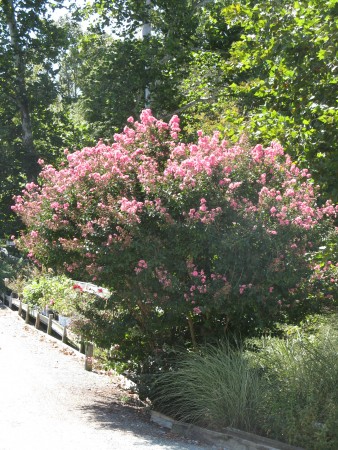
My enthusiasm for a southern shrub that has crept into our landscapes in the last two decades is rising rapidly.Crape myrtles have moved from my try it list to a recommended mainstay if you are looking for a long lasting summer blooming shrub.

I planted my first crape myrtle maybe 30 years ago on a southern slope. It most likely was a southern cultivar being sold by a northern nursery. Each winter it died back to the ground, but returned with new shoots each spring and yielded beautiful pink blooms by midsummer. It never got more than two or three feet tall.

Becoming knowledgeable of the breeding work being done, I tried some of the more hardy varieties.Starting about 15 years ago, I have planted more than 20 plants. None have been added in the last five years. The largest of the full sized varieties are now over 10 feet tall and wide. The dwarfs now would not fit into a bushel basket.

With the exception of two I sited incorrectly and removed, all the full sized plants are thriving. I lost several of the smallest dwarfs in the first few years.

Culturally, they like light but aren’t fond of wind. With our mild winter and the sunny dry spell of June and early July, they are putting on a show the likes of which I have never seen.  Plainly stated, they bloom on new wood based on light accumulation.

I am fascinated by a group of dwarfs planted along both sides of steps going down to my patio. The steps are on the east side of my house, thus falling into shade in the waning hours of the afternoon. One side is maybe 10 feet from the house and the other is fifteen.  For the first time ever, the ones closest to the house are heavily budded but are at least four days behind the ones on the other side. The other side is at least a week behind a nearby plant that never falls into the shade of the house.

My advice is still the same. If you wish to plant crape myrtles this fall, now is the time. Give them plenty of time to get acclimated. Otherwise, wait for spring. Let the ground freeze and then mulch lightly. Pay attention to light and wind.  

In a normal or colder winter you may experience some tip damage. Be patient as they are very slow to leaf out in the spring. I would wait until late May to remove any winter damaged twigs. By then my guess is that you will a have very little to remove. You get flowers on new wood so it is difficult to mess up unless you insist on snipping in June and July.

I’m sure the dwarfs are not quite as tough as the full sized ones, but they have improved. With the full sized ones I would stick to multi-stemmed bushes rather than trying to duplicate the single stemmed small trees you find in the south. The temptation is there, though. It has been written and sung that for everything there is a season. This year crape myrtles have delivered everything a season could offer.


Academy Award of Plants by Kris Barry


Its like the Academy awards of the plant world. Ok, so maybe not quite, but it is still a big deal.

The Perennial Plant Association- a group comprised of horticulturalist, educators, breeders and general plant enthusiasts get together every year and select a plant of the year. This groups also holds conferences, awards scholarships to horticulture students, and publishes some great written materials.

Beginning in 1990 each year an outstanding plant was chosen that surpasses the competition in adaptability, disease and pest resistance, multiple seasons of interest, and all around garden-worthiness.

If you are new to gardening, this list of 22 plants is a great place to start. (Available at http://www.perennialplant.org/education/past-winners).

Last year's winner- Amsonia hubrichtii, Arkansas blue star, is one of my all-time favorite plants. Topped with small blue star-shaped flowers in the spring, the delicate green ferny foliage grows to 3 feet, then turns a flaming yellow in the fall. It is absolutely spectacular planted beneath dogwoods to contrast with their red fall color. It grows well in sun or part shade, in moderate to dry soils.

This year's selection, Brunnera macrophylla 'Jack Frost', is a beautiful variegated cultivar of the Siberian bugloss. Again, small blue flowers in the spring, are its biggest appeal, but the variegated foliage holds up well the rest of the season. This plant is a great addition to the woodland garden growing well in part sun to shade.

Earlier winners have included such garden staples as purple coneflower, lenten rose, tickseed coreopsis, Japanese painted ferns, 'Rozanne' geranium, 'May Night' salvia, and 'Palace Purple' coral bells.

Not to be excluded, the American Hosta Growers Association started naming 'Hosta Of The Year' in 1996 to promote superior hosta cultivars that are in good supply and are offered for a reasonable price from the hundreds and hundreds of commercially available varieties. This year's winner 'Liberty' is a creamy variegated midsized variety. Past winners include my favorite 'Praying Hands' a vase-shaped narrow leaved variety,blue and yellow 'June' and the tiny 'Blue Mouse Ears'. Other winners can be found at http://www.hostagrowers.org/Hosta_of_the_Year.html

Various other groups offer tree or shrub of the year, vegetable of the year, even Bulb of the Year (if you're curious its Crocus 'Spring Beauty'). Like the Academy Awards, some choices are a little suspect. I have yet to see "The Artist" and will probably never plant purple peas. But hopefully these awards cut through the noise of hundreds of choices, and a give you a few good standbys when selecting plants for your home.


Our Trek North by Carlton Groff


Week four of July found us just north of the halfway point from the equator to the North Pole in the great north woods of New Hampshire. That’s closer to Canada than to a supermarket.

Our search was for cooler temperatures and some new scenery but our excuse was bird watching. The area is mostly wooded with an abundance of lakes and mountains.

The forest is dominated by a skinny spruce in addition to maples, light barked birch and a few aspen. The short limbed spruce easily sheds the heavy winter snow without breakage. The forest floor is a spongy collection of moss, tree roots and stones.

Wild blueberries, Joe-pye -weed, and fire weed were plentiful. Many of the lakes were dotted with yellow and white water lilies, a few cattails and large swaths of purple flowered pickerel weed.

Typical garden and container plants were exceptionally beautiful. I guess, here, our plants do pay a price for our higher temperatures and humidity.

Bird watching is hardly on the popularity radar up there. Now it’s ATV’s, boats and fishing followed by hunting , skiing and snowmobiles as the temperatures cool. If you are just looking, moose are the target.

Road signs everywhere warn that you don’t want to hit a moose with your car. Yet I learned the moose often hang out along the roads. The salt used to clear the roads of ice and snow drains to low spots along the sides of the road and become salt licks.

We saw our requisite moose along a road. We also saw several road side salt lick areas where the soil had been churned enough to make any dirt barnyard full of cows proud.

By the end of July bird watching is in a lull. Most young are out of the nest. The hormones and the singing wanes and the young usually don’t dress exactly like their parents.

We didn’t go with great expectations. Maybe what we didn’t see was more surprising than what we did. Being used to the crowds of waterfowl at the Octoraro Reservoir during migration I was shocked by how few we saw in their nesting area.

Our cabin overlooked a large lake that would have swallowed the Octoraro several times. At the check -in desk we were proudly told that there were three nesting pairs of loons on that lake. Not exactly what I had envisioned. Their nightly serenade, however, was a highlight of the trip.

Our target was to find one of several northern birds whose southern range ends just south of the Canadian border that we had never seen before. The other was to see 50 different species of birds in New Hampshire.

We got it all - cooler temperatures, interesting scenery and our bird goals. By the time you read this we will be back in town.


Share Your Love of Gardening by Kris Groff Barry


Everyone has a hobby they enjoy spending time doing. Whether it is bird watching, hunting, sports reading, or gardening. Usually these are activities that someone spent time showing you how to do. Either a family member or a friend expressed their love and friendship to you by saying -Let me spend time with you sharing something I love to do.

My father often tells of the hours he spent helping his elderly grandmother in her immense flower garden helping her divide perennials, cut bouquets, and harvest fresh vegetables. I know he enjoys birdwatching now more that mom has a set of binoculars too. I learned to sew painstakingly with my grandmother who enjoyed needlework. Now whenever I have time to do a few stitches, I am reminded of my time with her.

Where am I going with this? In the last week I visited with two customers at the greenhouse that were purchasing sizeable quantities of shrubs and perennials.  I enquired if there were adding to existing beds or creating new ones.  In both instances the plants were for their childrens homes.  Both were newly married couples who did not know anything about gardening, and their unlandscaped yards apparently bothered their mothers enough to drop several hundred dollars of their own money to fix.

Now having just benefitted greatly from my fathers now nearly-retired state in some landscaping improvemets in my own yard, I do not have a lot of room to criticize.  But in my humble opinion a better appoach would have been to bring the daughter or daughter-in-law (!) and spend some time seeing what colors they liked, what was in bloom, or what plants had the most butterflies around them.  It would have been a great way to share their obvious love of gardening with their grown children.

People seem busier today- and gardening is something that forces you to slow down.  Hulling peas or pulling weeds are not quick tasks.  Waiting for young transplant to grow is anything but instant gratification.  It is good for your psyche to slow down a bit.  At least it is for my Type A personality.  

My kids love watering.  Granted sharing gardening tasks with young children often takes longer.  Dragging the hose around when a lot of the water splashes on the mulch and tiny bare feet takes twice as long.  Sometimes the petunias get pulled up with the poke weed.  But the Monarch caterpillar is much more exciting to my 3-year-old than it is to my jaded eyes.  Taking a break to watch a parade of earwigs exiting the rotting stump with my 6-year-ild is something I will not see sitting in front of facebook.


Lessons from the Vegetable Garden by Carlton Groff


Once every several weeks, for the last 38 years, I climb up on a counter stool and sit quietly while my wife trims the hair on all sides of my head. The last time she pulled a nasty trick. The trimmings she was dropping on the barber’s apron were a lot whiter, I was sure, than anything she could have found on my head.

She insists there was no trickery, and perhaps as I realize that I am in my sixth decade of gardening ,she is right. That leads me to the question I frequently ask myself and one that should be common in everyone’s mind. What did I learn recently?

For the gardener it would be “what did I learn this season?” Despite the gray hair and long history my list this season would be longer than this article permits. Let me talk about three.

I have always been afraid of mushroom soil but I was also keenly aware that my garden was lacking in organic material, so this year I gambled. A bit more than half of the trailer load of fresh mushroom soil was scattered and tilled into about five thousand square feet of garden. The results have been overwhelmingly favorable.

Last week I banked my asparagus with an inch or two. Banking the raspberries and the strawberries are also an inviting project for the near future.

My next learning experience and a half came with potatoes. Several years ago, a friend told of laying the seed potatoes on the surface of the ground and covering with hay. They grew through the hay and were easy to dig.

I modified that idea, covering them with spent potting soil rather than hay. It worked. When I want potatoes I go to the garden and pull the stalk. No digging tool needed.

Next year I will do it again with a few changes. My mound of covering material (spent potting soil in my case) will be larger. I am finding some exposed and sunburned potatoes. Since potatoes are heavy feeders, I will add a bit of extra mushroom soil on the surface before I lay the seed potatoes down.

The potatoes were also part of my experiment with diatomaceous earth. Beetles have always been a problem with beans and potatoes. This year I hand scattered diatomaceous earth across the foliage of the potatoes and the beans. It was working, so as I sensed that the beetle pressure was increasing, I turned the plant foliage almost white.

Beetle kill was excellent, but there was significant and almost total leaf damage. After the fact, I read that diatomaceous earth can be toxic to leaves under some conditions when used in excess. Next on my agenda is to find a duster to apply it more thoroughly and in much lower quantities.

I had visions of a metal duster like the one dad used. It most likely dated to the 1930ies. Twenty, maybe 25, websites later I realized that my only choice is a plastic one that sells for less than 50 dollars. Throw in the probable ten year supply of diatomaceous earth I bought for less than 20 dollars and I’ll soon have the beetles on the run for a long time.

I was just thinking. Diatomaceous earth is a white dust. Did I do the beans and the potatoes on haircut day? Anyway, with free haircuts that is a few more dollars that can be put toward my next garden project/experiment and learning experience.

Next page