When mid July arrived I feared that hot weather could not be far behind. My solution was to get in the car, promise anyone that cared that I would return sometime and headed west looking for higher, cooler ground.
Above tree line I found snow and a plethora of tiny, but beautiful, flowers. Amazingly, despite heavy snowfall, which flees ahead of winds up to 150 miles per hour, they survive frigid temperatures with little protection.
What I also quickly realized was that I was in the homeland of one of my favorite perennials. We saw a wide variety of penstemons or beards tongue. Where they grow naturally they come in a variety of sizes and colors, including a deep purple that was a showstopper.
Therein lays the problem. We are dealing with a plant that thrives natively in a much drier and often cooler climate than we have. The good news is that it is such a wonderful plant that it has attracted the attention of those that breed and select garden-worthy plants.
With one exception, the offerings until recently were beautiful, but short-lived. The exception is Penstemon Huskers Red, a plant selected as Perennial Plant of the Year several years ago.
Found in a garden in Nebraska it is the odd ball among penstemons. It has mahogany foliage with pinkish white flowers followed by ornamental black seed heads. The amazing thing is that, unlike its kin, it thrives here and even favors soil on the wetter side of average.
More recent, extensive work with penstemons, mostly in the mid-west, has yielded a growing selection of varieties. It joins echinacea and baptista as dry land plants being bred or selected for our eastern, warmer, more humid gardens.
There are other recent inductions that warrant trials in our gardens. In all cases, except with Huskers Red, selecting a drier site in full sun will increase your chance of success.
Another surprise on our trip was the huge number of hummingbirds starting their migration south in late July and early August. One of our stays was at the mountain campus of Colorado State University. Outside their conference center were three hummingbird feeders.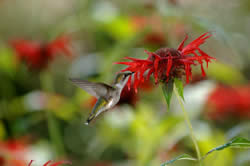
To my amazement, there were always dozens if not hundreds of hummingbirds near these feeders. They have a better selection of hummingbirds than we have. One was quite small and often bullied others away from the feeders.
Our instructor said that the little one often bypasses the feeders and uses the penstemon and monarda (bee balm) flowers as a source of nectar during migration.
We almost timed it right, as cooler temperatures arrived just ahead of our return. Our only problem may be that we started home a day too early since the car sensor read 107 degrees about halfway across Kansas.