Articles

Stay up-to-date on all we have in store, what we're growing, and our latest sales and deals!

Search »

Tomatoes


The time is fast approaching when frost-free gamblers and conscientious coverers will plant tomatoes. Give it another week or 10 days and you'll be safe to plant out your more tender vegetable garden plants. I'm talking tomatoes, cucumbers, peppers and melons.

This week I'd like to spend some time on tomatoes. Who doesn't like a nice, red, juicy, meaty, flavorful tomato fresh from the garden? I remember my grandmother eating tomato and mayonnaise sandwiches all summer long. My mouth is watering for a BLT as I write this.

Tomatoes fall into 2 categories: determinate (bush-types) and indeterminate (stake types). Determinate plants grow to a certain height, flower and produce their fruit in a short window. This type is good for those that want to use their fruit all at once to can, make salsa or tomato sauce. Examples of bush-types are Celebrity, Roma, Patio, and Red Grape.

Most tomato varieties fall into the second category; indeterminate. These plants can grow vines up to 10 feet long, and benefit from trellises or staking. They flower and produce fruit up until frost. I use the last of my green ones to make "Fried Green Tomatoes" when low temps are in the forecast.

A little about varieties. My favorite seed catalogue lists 82 varieties of tomatoes, some 25 of which are heirlooms. Most varieties Big Beef, Early Girl, Supersteak etc are F1 hybrids. They are bred for disease resistance, yield, size, shelf-life and shipping ability. Flavor is a secondary goal, however picked fresh off the vine they are quite tasty.

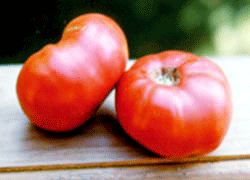
Heirloom varieties, which are gaining in popularity, have been passed down over the generations one seed packet at a time. They generally have very flavorful fruit, but are not as easy to ship, have lower yields, and more misshapen sizes. This makes them great for the farmer's market, not as great for the wholesale grower.

Most heirloom varieties have unique names, German Johnson, Arkansas Traveler, Brandywine, and my favorite, Mortgage Lifter. Mortgage Lifter was bred in the 1930s in West Virginia by a man named MC "Radiator Charlie" Byles. (I'm not making this up). He planted a German Johnson tomato plant in the center of a circle with all the other big-fruited varieties around it.

He then hand-pollinated the German Johnson plant and collected seeds. For several years he tinkered with them until he was satisfied with his creation. In a brave marketing scheme he sold the seedlings for $1 each, showing a lot of chutzpah for the 1930s, and was able to pay off his $6,000 mortgage in a few short years, hence the name Mortgage Lifter.

Whether you try an heirloom variety or stick with the proven hybrids, try some tomatoes in a sunny spot that you won't forget to water. A little compost mixed in the soil before planting or a shot of fertilizer during the summer will improve plant health. Stake or cage plants to support the weight of the developing fruit on delicate vines, and enjoy!

Photo Courtesy of Jeff McCormack.


New Annuals Pt 1


We were at a greenhouse symposium last winter and someone asked me if I thought the perennial craze was over. While I think perennials are definitely here to stay, I also think gardeners are realizing that for color all summer, annuals can't be beat.

For new gardeners and the more experienced (note I didn't say "old"), there are some exciting things happening with annuals.

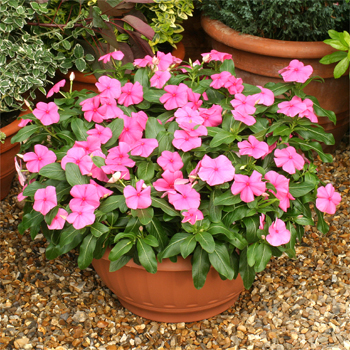
There are several new series of F1 vinca coming on the market Titan, Cora, Sundevil Extreme, and Cobra readily come to mind. This is a new innovation in vinca, a crop that is traditionally open-pollinated.

Open-pollinated crops are usually inbred lines that are grown in a field and open-pollinated by insects or wind. Not very labor intensive. F1 hybrids are a cross between 2 inbred parent lines that are emasculated, then hand pollinated to prevent any accidental pollination. This is very labor intensive, and thus the seeds are more costly, but the benefits are generally worth it. Larger flowers, more vigorous plants, more disease resistance are usual results.

In the trials last summer, I was very impressed with the disease resistance and flower size of these new F1 vincas.

For the new gardener, zinnias are a great choice as they are easy to grow, come in a variety of heights, and attract butterflies. Benary seed has a line of 3-4 foot tall cutflower types that are available in 13 different colors. I saw these in the Idea Garden at Longwood last summer, and they have excellent mildew resistance, stunning colors (lime green!) and good vase life.

The Profusion zinnia series is a dwarf mounding type with great garden performance, but not as attractive to butterflies. Three colors won the All-American Award; Cherry 1999, Orange 1999 and White 2001, but the new colors Fire, Coral Pink and Deep Apricot are just as wonderful.

Another great new old-standard is Non-stop Mocha begonias. The Non-stops are very floriferous, double begonias that come in a variety of colors and are great for part shade garden beds or mixed containers. The Mochas have stunning dark foliage that really sets off the colorful blooms.

I may never convince my friend who has a "Friends don't let friends buy annuals" bumper sticker on her car, but if you've turned up your nose in the past, you may want to try some of these new all-summer bloomers.


Geraniums and Osteospermums


Nearly 30 years ago I joined a tour of the research greenhouses at Penn State. The only thing that stayed in my memory was a beautiful plant, which in my opinion proved to be a garden flop.

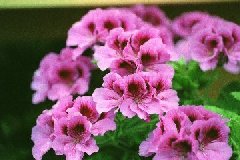
The plant looked like a geranium on steroids. It was about twice the size of the common zonal geranium. The leaves were likewise size exaggerated. The flowers were huge and generally bi-colored, favoring the range through reds, pinks and purples.

I think then they were called Martha Washington geraniums. I'm not sure what happened to Martha, but more recently they are usually called regal geraniums.

Before I forget it, the tour was in the late winter or early spring.

When I first saw them, the flowers made them a 'must have' plant. My first effort in April and early May looked just like what I had seen at Penn State. A lot of them found their way into my garden and in late May, June, July, August and most of September I had giant geraniums without a flower in sight.

As frost neared I remember a few flowers. I tried at least three years before I concluded that they were one of those beautiful early spring plants that belonged in the compost pile, not the garden, once the flowers started to fade.

Needless to say, last July as I strolled through the flower trials near Landisville, I stopped short when I saw them again. Only this time they were blooming beautifully. Over the years the researchers have mitigated the plant's problem. Historically, they refused to initiate buds once nighttime temperatures climbed past 50 degrees.

The 2007 edition was in full bloom in the heat of the summer. There will be a spot in my garden for a few of them again this year.

Another plant that I have had a nearly similar experience with is the Cape Daisy or Osteospermum. This one traces its nativity to New Zealand and Australia, which has a more maritime climate. That's less cold in the winter and less heat in the summer.

They appeared at least 10 years ago and the story is similar to that of the above geranium with some exceptions. They bloomed a bit later into the spring and were slow to succumb to the cold of late fall.

In other words, they started full of blooms, were green in the summer and bloomed quite well long after most annuals were killed. One year they held out until Christmas. That year I also cut fresh cauliflower out of the garden the week before Christmas.

Several years ago the breeders introduced a wide-petal series that blooms in the yellow and orange range. This group blooms well in the summer, but gives up a bit in hardiness at both ends of the season.

At the trials last year there were varieties of the original white to purple ones, with more narrow petals, that were blooming in the heat of the summer. It's a bit early to determine whether this new generation has hardiness equal to the early ones.

That's it. Two plant series that were in my garden, were discarded and will be back in 2008. If I plant them in 2009, I'll say time and research has produced some winning annuals.


New Echinaceas and Baptisias


This winter dad and I spoke at a local gardening club about native plants. Now, we could have gotten in trouble and actually given a definition. Since there are probably as many definitions as there were ladies in the room, we skirted the issue.

For someone in the nursery business targeting home gardeners, my definition can be a bit looser than the die-hards, and those doing restorations. I am willing to call native any plant, selection or cultivar that has a species native to the eastern US in its parentage. See, I told you I wasn't picky.

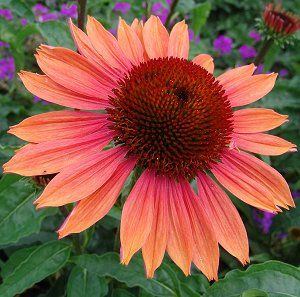
Case in point. Purple coneflower, Echinacea purpurea, is found in the wild from New York south to Georgia west to Colorado and Texas. No one can argue that it is native. How about some of the new cultivars on the market? These are crosses between the native E. purpurea and Echinacea paradoxa, a yellow-flowered form native to Texas, east to the Ozark region north to Missouri.

The Meadowbrite series, 'Mango' and 'Orange', as well as the Big Sky(TM) series comprising, 'Sundown', 'Sunset', 'Harvest Moon', 'Sunrise', 'After Midnight' and 'Twilight' all result from this cross.

Native? Maybe not, but with flowers ranging from yellow to peachy-pink, to deep orange and magenta, they're not the same old coneflowers, either.

The only problem with these new hybrids is they are vegetatively propagated, from cuttings, and won't come true from seed. If you like to let your coneflowers go to seed to feed the goldfinches over the winter, you may have some rouging to do next summer.

Another option is to plant a few specimens in front that get deadheaded and have some regular ones in the back to feed the birds.

Wild Indigo, or Baptisia is another genus where the breeders have been busy. The most common form available to us is Baptisia australis. It is native to the eastern US, and has beautiful pea-like blue flowers in the spring.

Also called 'Redneck Lupine' it is a member of the legume family, like lupine, but much more heat tolerant. It likes moist, hot, sunny places.

There are several yellow-flowered forms; the most common is Baptisia sphaeracarpa. The taxonomists are still arguing about the names for the white ones. For discussions sake, I'll call it Baptisia alba. The yellow and white species are US natives, but further south.

Chicago Botanic Garden has released some beautiful cultivars in the Prairie Blues series, 'Starlight', 'Solar Flare', and 'Twilight'.

Baptisia australis, our native, is in the parentage, but so are B. sphaeracarpa, B. alba, B. tinctoria and B. brachteata. 'Purple Smoke' and 'Carolina Moonlight' are also beautiful interspecific hybrids from North Carolina.

Native? Probably not, but at 2-3 feet and less wide, with bicolor flowers, I think I'd rather have them.


Spring is Coming


Spring is coming, I can feel it. The recent rain and warmer temps greened up my lawn, the birds are not frequenting my feeder as much as a month ago, and getting out of bed is getting easier.

Don't ask me about this new daylight savings schedule, though.

Last week I was poking around my flowerbeds looking to see who was peeping their heads up. Snowdrops are blooming, irises are starting to emerge and daffodils are showing some green. I found my first blooming crocus, but tulips have a way to go. Hellebores are shooting new leaves and will bloom shortly. If their foliage is looking tattered, they would benefit from a haircut.

As much as my fingers are itching, I'll leave the dead tops on my perennials a little longer, until I see the new green shoots emerging. We still may get a cold snap, and those tops offer protection to the crown and roots.

Now is a good time to thin some of your deciduous trees or non-flowering shrubs while they are still dormant. Pruning on apple trees, grapes, blueberries and cherries should be about done. Wait a little longer for the more tender peaches and nectarines, though.

Pruning your spring bloomers now will remove flower buds, but I have some old wood in my lilacs that's going to see my loppers this weekend. I'm too busy after they bloom.

This is one of my favorite times of year. I love the crisp brightness of the air, and the promise of warm weather coming. Go for a walk in the woods, or around your neighborhood. See what is starting to come up in your garden or neighbor's yard. Start some seeds indoors and plan your vegetable garden or flowerbeds.

Or just curl up with a good book and enjoy the last vestiges of winter.

Next page