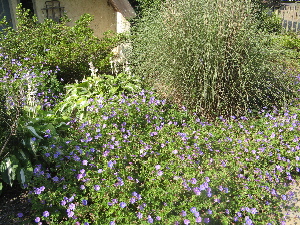
My neighbor has a beautiful hydrangea bush. It's lush and full and...green. No flowers. We'll come back to this in a bit.
There are four main types of hydrangeas. Two are native to North America. Two are found in Asia.
The first native hydrangeas to bloom are the snowball type, Hydrangea arborescens. This is your grandmother's snowball bush. It likes morning sun, but shade in the hot afternoons. This hydrangea can and should be cut down to about one foot every year. New breeding has strengthened the stems and enlarged the flowers. These are easy to grow.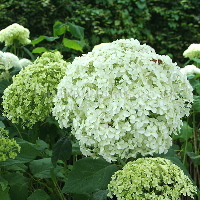
The oakleaf hydrangeas are the second native type. Hydrangea quercifolia is one of my top 5 shrubs. They're fantastic. They prefer part sun, have lovely large cream blossoms, that fade to pink and dry well. All in all you can have large blooms for several months. In the fall, the foliage has a nice red color. Ornamental bark provides yet another season of interest. It is also fairly foolproof. The oakleaf hydrangeas bloom on old wood, so do not prune after August, or you will cut off next ears flowers.
Hydrangea paniculata is the only hydrangea that can be trained into a tree form. It is originally from Asia. The flowers are cones rather than big balls. 'Limelight' and 'PeeGee' are common cultivars on the market. They like a bit more sun, and also bloom on "new wood". This means they can be pruned anytime except in the summer just before they bloom. They get fairly large, so give them some space.
The most finicky, but some argue the most beautiful, are the other Asian types, the mopheads and lacecaps, Hydrangea macrophylla. These are the ones that bloom in various shades of blue or pink. The color is largely due to pH. A more acidic soil gives a blue color, a more basic pH (above 7) gives shades of pink. If you want a bluer flower, add sulfur. If you want pink, add lime to your soil.
These hydrangeas set their flower buds the previous summer. In other words they bloom on "old wood". If you prune them in the fall, or we have a cold winter that freezes the tips- you've lost the flowers. This is the cause of my neighbor's green bush.
If you search the internet, there are elaborate methods describing how to protect them from damage. They involve chicken wire, leaf litter, some plastic sheeting, etc.
Luckily, there is a lot of current breeding to improve the cold hardiness of this type of hydrangea, as well as making the bloom on "new wood", or this seasons's growth. The first and best known variety is 'Endless Summer'. 'All Summer Beauty' is another of this type. As I look to the future, I see many more varieties in the pipeline, which bloom and rebloom on old and new wood.
A word of advice, if it comes wrapped in foil from the florist, you can bet it won't be hardy.
There are two types of vining hydrangeas. The true hydrangea vines(Hydrangea anomala subspecies petiolaris) are vigorous climbers, but don't like to bloom. If you want a climber, that actually blooms, try Schizophragma hydrangeanoides, false hydrangea vine. My parents have this growing up the side of their deck and it is gorgeous.
Hydrangeas are the queens of the summer blooming shrub border.If you have space, they're worth a try.
Photo ids: Top left Hydrangea arborescens 'Annabelle'. Middle Hydrangea paniculata in tree form. Lower left Schizophragma hydrangeanoides on Groff's deck.