Articles

Stay up-to-date on all we have in store, what we're growing, and our latest sales and deals!

Search »

Memorial Day Gardens


As one who is old enough to remember when Memorial Day was May 30 instead of a long weekend, I also remember that it also marked a milestone in my grandmother's garden. It still does.

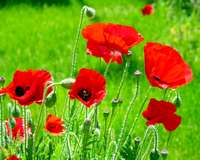
Grandmother always used Memorial Day as a reference when counseling a young boy waiting for spring flowers to unfurl. More than half a century ago the late May garden was built around peonies, bearded iris, Oriental poppies and a gangly wiegelia bush with red flowers.

As I look out my window today I see the same plants in bloom. What is striking is how different mine look than they did in grandmother's garden. Her peonies were double and red, pink or white. Our possible selection from the color palette and petal arrangements has grown considerably.

Her bearded iris were small flowered, and white, yellow, blue or a red and yellow bi-color. The Oriental poppies were orange. I've already mentioned gangly.

I'd bet that one would be hard pressed to find the plants that dotted grandmother's Memorial Day garden. If we could, they would be ho hum at best and I'm sure they would not go home to your garden. The plant side of the garden industry has worked great wonders, but at the same time may have destroyed the anticipation.

As I look around the blooms in my garden, there are multitudes of plants that grandmother would never have dreamed. Then, if you wanted to see mountain laurel you went to the woods. Today, I merely have to peer out my kitchen window or step out my bedroom door.

I could ramble on and on, but I guess I already have. My point is that Memorial Day, and I wont say Memorial Day weekend, is a high point in our gardens. The question is what's next.

How do we have the same beauty in our gardens say on Independence Day in July or on Labor Day in early September or even Thanksgiving in November?

Liberal use of annuals should provide the color answer to July and September.

But you say I want a perennial garden. Then I have two suggestions. Crack the books and create a succession of bloom through plant selection. The easy way to do the same thing is to set a plant budget and hit the nursery for blooming additions each month. I don't care whether your budget is two or twenty plants, you will get there.

Oops, in my exuberance I put Thanksgiving in there so I better say something... For that one you need to think evergreens, ornamental grasses, bark and berries. That isn't hard.

It's fun to remember the anticipation I had each spring with grandmother. Watching my older grandchildren, all under age four, I fear that it is me who has changed more than the garden.


Perennials in Containers


A recent trend is to use perennials in container gardens. As one who might get above average grades in plant growing and very low grades in design and conventional marketing I view this as assigning the plant to death row with little hope for reprieve.

Let's begin with the requirements for a plant to survive in a pot for more than one season, or more specifically the winter. Unlike in the ground a pot will track air temperature and be significantly effected by the absorption from the sun.

Research would suggest that the plants soil ball might easily exceed 75 degrees on a sunny winter afternoon and fall to the air temperature overnight. Swings of 60 to 80 degrees are very possible. When does that happen in our normal growing season?

To survive our zone six winters in a pot a plant must be rated as zone four. I think that's minus 20, which reflects winter conditions in the upper Midwest. Most conifers are on the short list of zone 4 plants we see in our greenhouses or garden centers.

The designers will tell you that the perennials in containers will do double duty. Their saving solution is to breakup the container in the fall and plant its perennial components in the ground. My guess is that by September 1, the container plants are either stressed or they are one of the highlights of your garden. If they are a highlight most of us would delay ripping the container apart until frost in late October or even November. By then we are pushing the desireable window for fall planting.

This concept of a double duty reprieve is sound but I doubt if it happens successfully very often.

A second chance to save the perennials is to dig a hole and bury the container so the plants it contain will think they are planted in the ground. This would work but would be more effort than most of us will undertake.

The third option is to move the container to an inside location that is cool with low light after the plants have entered dormancy. They may need to be watered several times over winter but keep them on the dry side. My guess is that a temperature between 25 and 35 degrees would give the best results.

Unless you are featuring foliage I see little merit using perennials with short blooming periods in containers when the greenhouses or garden centers are full of annuals that will bloom their hearts out from purchase to frost with the same care.

Given our limited selection of zone 4 plants building containers around perennials is not the best idea horticulturally. If you have no problem turning a perennial into a non-perennial go ahead. I frequently kill plants unintentionally but hate to see them assigned to death row from the start.


A Wet Spring


After a cool April, that ended in a few days of 90 degree temps, followed by what seemed like way too much rain, May is finally bringing forth flowers. These particular weather conditions might have caused some problems in your garden.

The first warm temperatures tempt us to plant out annuals and tender veggies before we are clear of the frost free date. I suspect some early planted vincas, tropical annuals, cucumbers and zucchini are suffering. If you want to plant these early, they must be protected from freezing or a frost. Cover individual plants with overturned milk jugs, or protect an entire flower bed with a sheet staked at the edges to prevent it from touching tender leaves.

Frost generally occurs in the early morning, from 3-6am when the wind is still and temperatures are in the mid thirties or lower. Dew is created when the water vapor in the air cools to the point at which it condenses (the dew point). When it is cold- instead of dew we get frost. Frost forms on any object below 32F when the dew point is reached.

Remember warm air rises. The coldest air will be right around your begonias and tomatoes. If there is a mild wind, 10 miles per hour or so, the air doesn't separate. This reduces the chance of frost. Cloud cover also makes frost more unlikely.

The best thing is just to be patient. Finish your garden cleanup and plant perennials on those first warm days.

Ten days of rain also gave us some problems. While I was on the lookout for animals marching by two-by-two, I also watched helplessly as my grass grew over my knees. The weeds in my vegetable garden are completely shading my carrots.

When the soil is that wet, weeds, lawns and garden plants can grow very lush. Insect pests, and slugs in particular, are especially active. Slugs like to feed on tender foliage when the temperatures are cool and skies are overcast. Dahlias and hostas seem to be a favorite treat.

A few home remedies exist to treat slugs. A dish of beer buried at soil level attracts them, and then they are supposed to drown. Not only does this sound gross, not everyone keeps beer in the house. Some people swear by crushed up eggshells around the stems of susceptible plants. Supposedly slugs don't like to crawl over the rough surface. A 10% ammonia solution sprayed on the leaves might also work.

There are several slug baits on the market which seem to have quite a following among the garden blog scene. Look for one containing iron phosphate. Some of the older baits were more harmful to kids and pets. If you're worried, ask.

I didn't hoe the weeds in my vegetable garden. Some may accuse me of laziness, but I feel I have an excuse. What is not in soil, air, is just as important as what is. The air spaces in the soil must make contact with the roots. Filling this space with water for long periods of time is harmful. Compressing the soil when it is wet completely removes these spaces. Walking on sodden beds will basically ruin them. Perhaps I am a bit lazy but again I find that patience is a virtue.


Our Farm Fields


This column was prompted by a rather unexpected request made to my wife at the Solanco Fair last fall. The suggestion was to write about what is happening or growing in the farmer's fields during the year. Here's an effort from a long time observer, not an expert.

Corn, soybeans and hay, mostly alfalfa, are the chief area crops.

If you have seen yellowing or browning grass fields recently they are or soon will become cornfields. The grass was planted as an erosion control, to add organic matter to the soil, weed control and to shade the soil to hold moisture. Real farmers may smile or laugh at the last reasons.

At this date most corn should be planted but, I suspect that the cool, damp spring has caused delay. Researchers will tell us that delay beyond the first week of May will reduce yields.

Most corn grown here is used for animal feed, often on the farm where it was grown. In early September, many acres of corn are cut, stalk and all, and put into silos, a bulk feed for cattle. The rest of the corn is harvested for grain, usually in October or early November.

Soybean plantings have increased in this area over the years. They are planted immediately after the corn is in. Although soybeans are a component of cattle feed, most are sold as a cash crop.

Alfalfa is the dominant hay crop with newer varieties yielding up to four or five cuttings per year. First cutting would be about now. The first cutting will give the largest volume, but is often a bit less choice hay.

In the fall or very early spring, if you see a finely tilled field, it is most likely destined to become an alfalfa field. Alfalfa is a perennial crop that can be harvested three or more years after planting.

Much hay remains on the farm to be fed, but there is an active market of selling hay to horse farmers.

You will see a declining acreage of small grains: wheat, barley, oats and rye. Often, the straw used as livestock bedding is more valuable than the grain.

The area's chief cash crop historically is tobacco. For obvious reasons, this acreage has declined significantly. Tobacco is started from transplants in late May or early June and cut and dried beginning in late July or August.

With the decline of tobacco as a cash crop, farmers, especially those with smaller acreage, have searched for new cash crops.

One that has caught hold is the growing of pumpkins for the Halloween market. Small acreage is devoted to growing produce for individual summer farm stands.

The arrival of a local produce auction also has increased the outlet for larger fields of vegetables. Most commonly seen are cabbage, sweet corn, cauliflower and broccoli.

I am amazed that I just wrote that, but then again, I was shocked to see a dog on a leash about six miles from Quarryville about ten years ago. I guess our demographics are changing.


Microclimates


Twas the 17th of April and hardly anyone noticed the fate of two magnolia trees growing barely a half-mile apart on nearby less trodden roads. The flowers on one were black as coal while the other explained why we try to grow magnolias here. You remember the frosty mid-April mornings.

First, let me explain about magnolias and a number of other plants that we have borrowed from coastal Japan, China and Korea. Near large bodies of water spring arrives slowly, not with the wild swings we experience inland. If the plant is native to a coastal area and it sees warmth, it expects it to continue, and can occasionally get in trouble if we have wild temperature swings at the start of the season.

From an historical point of view, I remember that in the orchard business it was frequently said that if the site had a 50-foot elevation drop, it was frost-free. I found that to be true, but that was occasionally offset by exposure to winter winds

This spring has also brought an interesting study about the wind. Two maples planted less than eight feet apart on either side of the walk leading to my front door responded very differently. Both are protected from the wind by the house but the one that is first to notice the wind sneaking closer leafed out about a week later than its more protected twin. It also is showing more dead wood.

I believe that this has been one of our worst winters for wind damage in the last decade. I see more crisp foliage on hollies and conifers than usual. I even see damage on a native plant that because of previous experience I thought I had given a sheltered location.

Further down the walk I have planted identical crape myrtles on both sides. Plants on the house side get just a wee bit more shade than the ones less than eight feet across the walk. The away side blooms much better that the side toward the house. I know that crape myrtles like lots of sun, but less than eight feet in full morning sun?

The above examples were cited to encourage you to think about what you plant and where you plant it.

Exposure to wind is, in my opinion, the worst offender in damaging plants in our landscape. March seems to be the worst offender. Trees and shrubs take more damage than perennials that die back to the ground.

Plants that must spend the winter with their feet wet closely follow the wind. Although this affects some shrubs, herbaceous or die back perennials are in more danger here. Recently I had conversations that continue to suggest that our immaculate fall cleanups also contribute to the demise of some perennials. Of course, late fall/early winter pruning is dangerous to the well being of many plants.

With the push toward native plants it should be noted that they have specific requirements and will not be happy unless those conditions are met. It is easier to duplicate the desired sites for natives, though.

The bottom line is that we live in a world of microclimates. The successful gardener learns to deal with those that exist on his or her property.

Next page