Articles

Stay up-to-date on all we have in store, what we're growing, and our latest sales and deals!

Search »

Slow Down!


I'm about to launch a crusade to have the word 'instant' removed from the dictionary. Let me explain my motivation.

Way too often I overhear conversations that suggest that an eager gardener is about to transform the local equivalent of the Amazon jungle into a timeless, manicured landscape treasure in a single afternoon.

In this political season I may have spun that last paragraph a bit too tight, but I hope you get the picture. Good gardens evolve over time. Any time I have tried to rush the effort I've paid the price with at least a lot of extra maintenance.

Before you think about good plants, you should think about the bad ones. What are you going to do about the weeds? In problem areas, adequate weed suppression can take a full season. One spray or one cultivation won't do it. Smothering them with a cover for a season works well.

After a bit of spot spraying, a lot of hand pulling and a modest amount of mulch, most of my beds are relatively low maintenance. My wife might claim I hold that opinion because she does most of that work.

On the other hand, my vegetable garden, which also gets cultivated, still seems to house an unlimited supply of weed seeds.

The second fault with instant, is plant selection.

After a several years of thinking, I spent big bucks to buy two Japanese Maples to straddle the walk leading to my front door. Since they are very slow growing, I bought plants that had been growing for some years. That was three summers ago.

The first year was spent worrying that they were going to die. Since I knew that maples generally do not like excess water, I resisted the temptation to help them die by drowning.

A year later they looked better, but I was still afraid to measure their progress because I suspect that the tape measure would show them shorter than when I planted them. Despite the fact I wrapped then for the winter, I got some tip dieback. Daughter Kris even started to question my selection wisdom.

Finally, in year three I see reasonable new growth and the fullness that I had hoped for.

I'll share an industry secret. In the spring you can take many five-cent perennials, put them in a larger pot and have a ten-cent perennial in a month or less. Since you won't find five-cent perennials, I'll let you think about the arithmetic.

Done thinking. That could be two dollar to four dollar, five dollar to 10 dollar or 10 dollar to 20 dollar. The same thing will happen in your garden, and you will have money for more plants or gas to go get them.

With woodies, of course the clock slows down, but you will be shocked about how short the catch up time is.

If my crusade fails, perhaps we can slow the pace of instant and make it more fun, relaxing and leisurely. That's all our gardens really owe us.


Spring Beauties


The beauty, or perhaps I should say glory, has now faded from the array of small spring blooming trees that dot many of our landscapes. My mind wonders if some of these are heroes and others should be relegated to the jayvee team.

It started last winter when I received a call from a grounds maintenance person from one of the largest companies in the area. His boss loved flowering cherry trees, but the crew was faced with near-ugly by mid to late summer.

Cherries, ornamental and fruiting, face a number of leaf fungi, which left untreated, will almost denude the tree by late summer or early fall. Young cherry trees are a bit winter tender, which may contribute to cherry's reputation as short lived. I would define short as 15 to 30 years.

My pink dogwoods that are of native extraction, were showstoppers this spring. I have them planted in an airy spot and so far they have escaped the diseases that have greatly reduced the dogwood population in its native location. Some have switched to the later blooming Kousa dogwood, which is disease resistant.

More recently, there are hybrids that incorporate just enough resistant blood into the natives to make than resistant. I have about a dozen in the ground and am very pleased to date.

Serviceberry is another favorite native small tree. It is often seen as a large multi-stemmed shrub. It's a white cloud when it blooms and provides good berries for the birds. Its fault is that given high temperatures or rain the blooms fade almost overnight. They last only three or four days under perfect conditions.

Magnolias come in sizes ranging from nearly 10 feet to trees in excess of 30 feet. They originate from the maritime climates of eastern Asia. Here, they can be surprised by early warm-ups followed by stiff frosts. They were great this spring but suffer once every three to five seasons.

We can't forget the tall skinny Bradford pear that is, or more likely was, a favorite a few years ago. I've already defined its shortcomings by describing it habit. Any time you have a branch at a tight angle to the central stem, it is weaker. I have seen lots of fatal breakage in this pear, but still have some near 20-year-old specimens that are beautiful in the spring.

More recently there have been pear introductions that give wider branching and thus better trees.

Flowering plums and redbuds travel the same road of cherries, with the redbud holding out against the fungal diseases a little bit better.

Finally, there is one that is quite uncommon. Blooming now, it's a native called fringe tree or old man's beard. Blue berries, that the birds will swarm, follow the blooms. The Latin is Chionanthus virginicus.

Did I answer my original question? No. I've got all but the cherries currently in my landscape and I have a few pots of them looking for the right spot. Each has its faults, but you will never convince me of that during the spring bloom.


New Annuals Pt 2


Several weeks ago I talked about some new annuals I though worth investigating. I have a few more to add to the list.

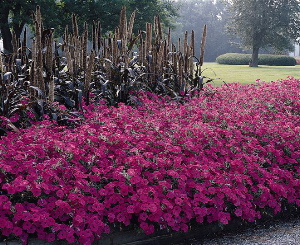
Ball keeps adding new lines to it's "Ride the Wave(TM)" petunia phenomenon. Several years ago, Purple Wave(TM), bred by a Japanese beer maker, revolutionized the petunia market. Its vigorous, trailing, ground-hugging habit made it a favorite for landscapers and home gardeners. The effort Ball spent advertising it didn't hurt either.

Next came the Tidal Waves(TM), a taller hedge-type petunia just as vigorous, but almost 2 feet tall. The Easy Waves(TM) followed. More similar to the original animal, but slightly taller and not quite as vigorously spreading. This year the Shock Waves(TM), a small-flowered type, geared for hanging baskets and containers, joins the family. All of these are F1 hybrids, sown from seed. All come in various shades of pink, purple and white.

Several companies have tried to answer the success of the Waves with vegetative trailing varieties. In my humble opinion, from what I've seen at the Landisville trials, the Supertunias from Proven Winners give them some good competition. Both on the strength of their performance and their marketing campaigns.

Someone slap my wrist.

Harkening back to my science fair days when I grew marigolds up in my bathroom under Gro-Lights, I've always loved these tough, sunny bloomers. Whether grown in milk cartons by kindergardeners, planted at the edge of a vegetable garden to deter rabbits or at home in the flower beds, I think they're great.

Often overlooked because they are somewhat pedestrian, a perusal of a seed catalogue detailing the French, African, Anemone and Xanthophyll-rich types (to feed to chickens to improve skin color) will make your head spin.

When my dad was first starting in the greenhouse business, a white marigold was highly desired. Now we've been through several permutations, 'Sweet Cream' and now 'Vanilla' make great African, large-headed, white choices.

Last fall people came in looking for marigolds when I wanted them to be looking for mums. The oranges, yellows and reds make great fall color additions, and since they bloom up to frost, marigolds planted in the spring still looked great in September and October.

Both marigolds and petunias are worth a second look this spring on your trip to the garden center. Long-blooming and garden-tough. they won't disappoint.


Vines


So you want some vines to plant around a fence, trellis or front porch. What should you get?

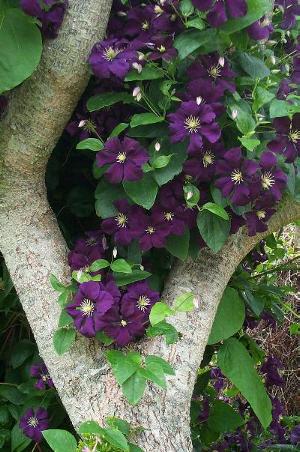
Vines come in two or three varieties- annual or perennial. Perennial vines like clematis, false hydrangea vine, trumpet vine, hardy jasmine, come back every year, and may even stay somewhat evergreen over the winter. Like regular perennials, they have a limited bloom window, then quit.

Our Amish friends tend to grow the best-looking clematis I've ever seen- their secret is to add a small handful of lime to the soil at planting and then every year afterwards.

One of my new favorites is Carolina Jasmine. It is a fragrant evergreen vine that blooms about now. It's great if your eyes can stand more bright yellow after the forsythias and daffodils.

Annual vines, like morning glories, cypress vine, hyacinth bean, sweet peas or scarlet runner bean bloom their little hearts out all summer, and then die. You could try to bring them in, but would most likely not be rewarded for your efforts. Besides, which, getting them untangled would be a mess.

They may, however, reseed themselves (check out a fencepost near our driveway in July, the Cypress vines come up by the thousands). Then are spectacular in September.

The third kind is tropical perennials- not hardy here, but perennial in the south. These are the ones you can bring in year after year- Mandevillas, bougainvillea, pink Pandora vine, and passion flowers. They tend to bloom most of the summer.

I like vines because they grow quickly and can hide things you don't want to see. Your porch railing needs painting? Your neighbors chain link fence an eyesore? Plant a vine.

You want some height in a mixed container and don't want to do spikes again? Add a hoop or small trellis and a vine.

Unfortunately most vines need sun. About the only one I can think of for shade is Schizophragma- false hydrangea vine.

Annual or perennial, ornamental vines add color and visual interest to most landscapes, and don't have to eat your house.

Photos: Top left Clematis 'Venosa Violacea', middle right Morning glory 'Heavenly Blue', Bottom left Schizophragma 'Roseum'.


Bed Preparation


Daughter Kris has argued that I need to write an article about bed preparation and planting. To me that is an easy assignment.

You dig a hole, put the plant in it at the proper depth, dump in a bit of water and cover the roots or root-ball. About the only place you can screw up is with the planting depth. Generally, if you plant at the same level as it was in the container you purchased, you are safe. Experience or asking questions will help you refine that process.

Almost without exception, the natural soil in our area will support most of our plants with little effort. The only thing that is slightly out of whack is the level of organic material in the soil. Adding compost may not be necessary but is never a bad idea.

Although we are blessed with calcium-based soil, pH can also be an issue to address in a few instances. Rhododendrons and their friends like it a bit more acidic but are seldom a problem. Growing blueberries or blue hydrangeas will require a bit of a struggle to lower the soil pH. A few garden vegetables, like sweet corn, may call for additional lime occasionally.

If you live in an existing house, dig and plant. New construction may be a bit dicey. It seems the building process calls for the removal of topsoil, building and then spreading a layer of topsoil on top of what is left.

This causes two problems. First you end up with less top soil than desirable because they sell the rest and any time you move or add soil you are temporarily destroying the natural capillary action of the soil. Time will heal both of these problems.

I almost forgot what I consider to be the most important factor. What about weeds? Simply put, they are easier to deal with before you plant. My advice is to slow down and do it, even if it delays planting.

Right now I am intently watching the roadside of a new development in the area. On day one they made a ridge, or mound, with the topsoil that will be missing from some future yard. On day two they planted thousands of dollars worth of plants. Then they threw eight handfuls of mulch around each plant. I counted. By week eight the weeds are coming with vigor.

I'll end with my favorite gardening experience. Fifteen years ago it was late March and I was struggling to open a new business. It was a wet spring and I needed a walk to several greenhouses. Of course the leveling bulldozer had raped the site of its topsoil.

With my trusty 60 horsepower tractor I plowed through the mud with scoop after scoop of stones. We opened, and the ruts stayed undisturbed for several months. After the spring rush I drug about a half dozen torn bags of peat moss across the ruts. Next came the rototiller. Finally, I grabbed leftover perennials and stuffed them in the ground.

The next spring more people than I could count asked me who designed that garden.

I fear daughter Kris will be dismayed at this edition. If it's too bad maybe she will write giving you proper instructions next week.

Next page